
Verticillium wilt — Tomato
Verticillium dahliae
Symptoms
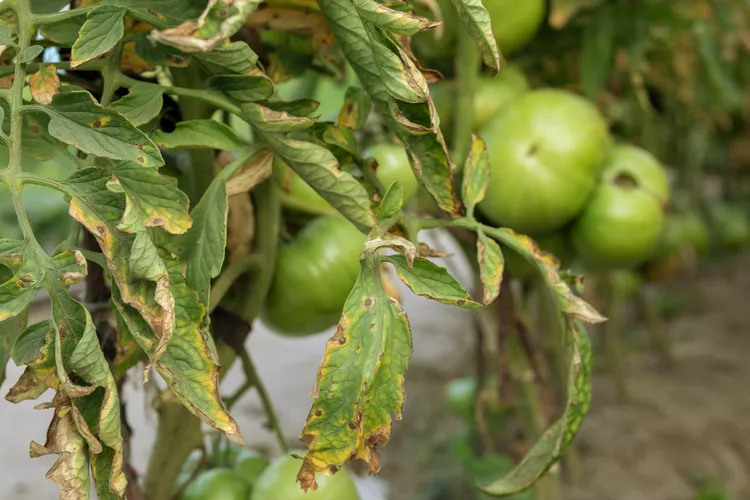
The earliest visible signs almost always begin on the oldest, lowest leaves and slowly move up the plant. V-Shaped Lesions: This is the most distinct hallmark. Yellow (chlorotic) patches develop on the margins (edges) of the lower leaves. These patches usually form a distinct "V" shape, narrowing inward toward the leaf's midrib. Necrosis: The yellow tissue eventually dies, turning brown and dry. The transition zone between the dead brown tissue and the healthy green tissue often has a prominent yellow halo. Leaf Drop: As the disease progresses, these lower leaves completely wither, dry out, and drop off the plant. Because the fungus attacks the xylem (the water-conducting tissue), the plant struggles to stay hydrated, even in damp soil. Diurnal Wilting: The plant may droop or wilt during the hottest part of the day when transpiration rates are high, but then mysteriously recover overnight or during cool mornings. Stunting: Infected plants are noticeably smaller and less vigorous than healthy counterparts. Asymmetrical Symptoms: It is common for symptoms to appear on only one side of a plant, or even just one side of a single leaf, depending on which vascular bundles are infected. Vascular Discoloration: If you slice the main stem vertically or make a cross-section near the soil line, you will see a light tan to light brown discoloration just under the surface in the vascular ring. Unlike Fusarium: This browning is usually lighter in color and extends only 10 to 12 inches up the stem. In contrast, Fusarium wilt causes a dark brown/black discoloration that extends much higher up the plant border.
Recommendations
No recommendations available